
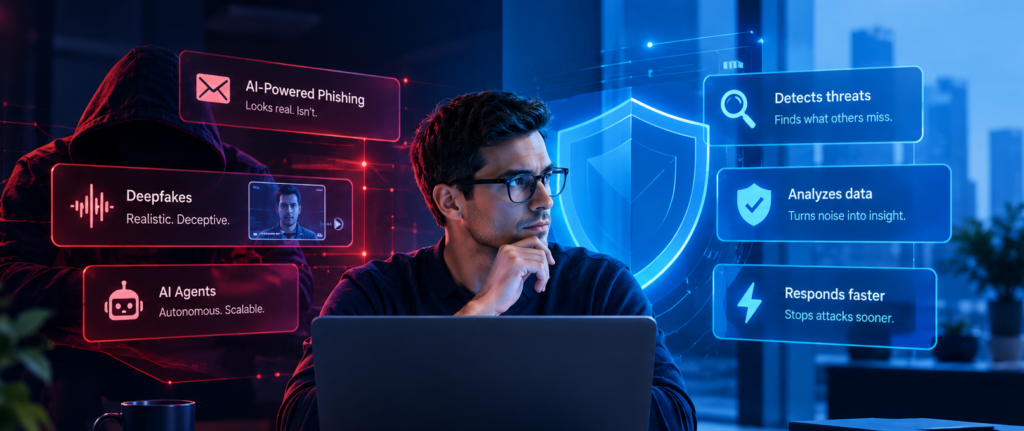
Artificial intelligence is quickly becoming part of everyday life. We use AI to write emails, summarize documents, create images, analyze information, and automate routine tasks.
But there is another side to this transformation.
The same technology that helps businesses work faster can also help cybercriminals create more convincing attacks, automate malicious activity, and operate at a scale that was difficult to achieve before.
The good news? AI is not only helping attackers. Cybersecurity teams are using it to detect threats, investigate incidents, identify suspicious behavior, and respond faster.
The result is a new cybersecurity race — and every user is now part of it.
AI Has Changed the Cybersecurity Game
Cyberattacks have traditionally relied heavily on human effort. An attacker might spend hours researching a target, writing phishing emails, looking for vulnerabilities, or trying to avoid detection.
AI can speed up many of these activities.
Generative AI can help create convincing phishing messages, develop social-engineering scenarios, identify potential attack paths, and even assist with malicious code. Some underground services have already offered AI-powered tools specifically designed for criminal activity.
For an attacker, the attraction is simple: more automation, less time, and more convincing results.
That doesn’t mean AI automatically makes every attack successful. Security controls, user awareness, and human oversight still play a major role. But the barrier to creating sophisticated-looking attacks is getting lower.
Phishing Doesn’t Always Look Like Phishing Anymore
For years, one of the easiest ways to identify a phishing email was poor writing.
Strange grammar. Spelling mistakes. Awkward sentences.
AI is changing that.
An attacker can use AI to create a professional-looking message that sounds natural and matches the tone of a real business conversation.
Imagine receiving an email that appears to come from your manager:
“Could you take a quick look at the attached report and get back to me before the meeting?”
There may be no obvious spelling mistakes. The language may sound completely normal.
That’s why users should stop relying on grammar and spelling as their primary defense.
Instead, pay attention to context and behavior.
Is the request unusual?
Is someone asking you to open an unexpected file?
Are you being asked to transfer money or share sensitive information?
Does the message create unusual urgency?
When something feels different from the normal way a person communicates, verify it through another channel.
Deepfakes: Seeing Isn’t Always Believing
AI-generated media creates another challenge.
Attackers can use AI to create or manipulate video, images, and audio. A fake voice message could appear to come from someone you know. A manipulated video could make someone appear to say something they never actually said.
This creates a new problem for organizations:
Can we still trust what we see and hear?
Sometimes, even visual inspection can reveal clues. Unnatural lip synchronization, strange eye movement, inconsistent lighting, unusual facial movement, or other visual inconsistencies may indicate manipulation.
But there is an even simpler defense:
Verify unexpected requests.
If someone sends you an unusual voice message asking for money, credentials, confidential information, or an urgent action, don’t rely on the voice alone.
Call them directly.
If an executive suddenly asks for a sensitive action, confirm the request through another trusted communication channel.
A few seconds of verification can prevent a serious security incident.
The Next Step: AI That Acts on Its Own
One of the most important developments in AI is the rise of AI agents.
Traditional chatbots primarily respond to questions.
AI agents can go further. They can plan and execute multiple steps to accomplish a goal.
That capability has enormous potential for legitimate business use — but it also introduces new security challenges.
Security researchers have already demonstrated scenarios involving AI agents discovering vulnerabilities, interacting with other agents, searching systems, and performing actions with limited human intervention.
This means the future of cybersecurity isn’t only about stopping a human attacker.
Organizations increasingly need to think about how to secure systems that can be targeted or manipulated by automated agents operating at machine speed.
But AI Is Also Fighting Back
There is an important part of the story that is sometimes overlooked.
AI is not exclusively an attacker’s tool.
Security teams are using AI to make defensive operations faster and more effective.
For example, AI can help security professionals:
- Identify suspicious behavior across devices and users
- Analyze large volumes of security alerts
- Detect unusual network activity
- Investigate potential malware
- Prioritize vulnerabilities that require immediate attention
- Identify potential attack paths
- Automate parts of incident response
- Help security teams investigate threats using natural-language questions
Instead of manually searching through thousands of events, a security analyst may be able to ask a security platform a simple question such as:
“Show me devices connected to the internet that have critical vulnerabilities.”
AI can then help analyze the available information and guide the analyst toward the areas that require attention.
The goal isn’t to replace security professionals.
It’s to help them move faster.
Why Human Judgment Still Matters
AI can analyze enormous amounts of information, but that doesn’t mean organizations should hand over security decisions without oversight.
AI systems can make mistakes. They can misunderstand context, produce incorrect conclusions, or be manipulated by attackers.
That is why a strong cybersecurity strategy still depends on a combination of:
Technology + Security Controls + Human Awareness
AI can identify a suspicious event.
A security professional still needs to understand what happened and decide how the organization should respond.
Similarly, an AI system may flag an unusual email, but users still need to recognize when a request doesn’t make sense.
What Can You Do to Protect Yourself?
You don’t need to become a cybersecurity expert to benefit from better security habits.
A few simple practices can make a significant difference.
1. Don’t trust a message simply because it looks professional
AI can produce polished emails, messages, and documents.
Look at the request itself, not just the quality of the writing.
2. Verify unusual requests
If someone asks for money, passwords, confidential information, or an unusual action, verify the request through another communication channel.
3. Be careful with links and attachments
Even a perfectly written message can contain a malicious link or file.
If you weren’t expecting something, stop and verify it before opening it.
4. Use strong authentication
Multi-factor authentication adds another layer of protection if a password is stolen.
Organizations should also consider stronger identity controls such as risk-based authentication and conditional access.
5. Keep devices and software updated
Security vulnerabilities are regularly discovered in operating systems and applications.
Updates can include fixes for vulnerabilities that attackers may attempt to exploit.
6. Treat AI-generated content with appropriate skepticism
AI-generated text, images, audio, and video can look convincing.
When something is unusual, unexpected, or asks you to take an important action, verify it.
The Future of Cybersecurity Will Be AI-Powered
AI is changing cybersecurity on both sides.
Attackers can use it to automate and improve their techniques.
Defenders can use it to analyze threats, detect suspicious activity, prioritize vulnerabilities, and respond to incidents faster.
That means the question isn’t whether AI will affect cybersecurity.
It already does.
The more important question is whether organizations are prepared to use AI securely while protecting their users, identities, data, and systems.
For everyday users, the lesson is surprisingly simple:
Don’t assume that something is trustworthy just because it looks real.
As AI becomes better at imitating people, organizations and individuals will need to become better at verifying information, protecting identities, and recognizing unusual behavior.
The future of cybersecurity won’t be about choosing between humans and AI.
It will be about making humans and AI work together securely.
Staying Ahead of the Threat
As AI continues to evolve, cybersecurity strategies need to evolve with it.
Organizations should consider how AI is being used across their environment, what data employees are sharing with AI tools, how identities and devices are protected, and whether security teams have the visibility and automation needed to respond to modern threats.
At Spherium, we help organizations strengthen their security foundations and prepare for the evolving threat landscape — from identity and endpoint protection to Microsoft security technologies and AI-related security challenges.
Because in a world where attacks can become increasingly automated, security can’t afford to stand still.